The most common question we get from Imlil is simple: should I climb Toubkal in 2 days or 3? Both itineraries reach the same 4,167 m summit, but they feel very different on the ground. Choosing between a Toubkal trek in 2 or 3 days comes down to your fitness, how you handle altitude and how much of the High Atlas you actually want to see.
Below we compare both options day by day, with honest pros and cons, so you can book the one that matches you.
Toubkal trek 2 or 3 days: the quick answer
Choose 2 days if you are fit, short on time, travelling in summer and have hiked at altitude before. Choose 3 days if it is your first time above 3,000 m, if you travel in spring, autumn or winter, or if you want to enjoy the trek rather than race it. The extra night mainly helps your body adapt to altitude, which is why first-time trekkers usually feel better on the 3-day version.
Side-by-side comparison
| 2-day trek | 3-day trek | |
|---|---|---|
| Day 1 | Marrakech → Imlil → refuge (approx. 5–6 h walking) | Marrakech → Imlil → refuge, or a gentler first stage |
| Day 2 | Summit at dawn, then descent all the way to Imlil and Marrakech (approx. 8–10 h) | Summit at dawn, descent to the refuge or a lower village |
| Day 3 | — | Relaxed walk down to Imlil and transfer to Marrakech |
| Acclimatisation | Minimal | Better: an extra night to adapt |
| Difficulty | Hard, very long second day | Moderate to hard, better spread |
| Best season | June–September | All year (essential in winter) |
| Price on our site (approx.) | From about €165 per person | From about €135 per person |
Prices are indicative starting prices shown on the trip pages and depend on group size, dates and options; always confirm the current price when booking.

The 2-day Toubkal summit trek in detail
The 2-day Toubkal summit trek from Marrakech is the fastest way to stand on the roof of North Africa. You leave Marrakech in the morning, drive about 1.5 hours to Imlil, then walk up the Mizane valley past the shrine of Sidi Chamharouch to the refuge. After an early dinner and a short night, you start the summit climb around dawn, reach the top, and then descend over 2,400 m back to Imlil in the same day.
Pros:
- Fits a short Marrakech holiday or a long weekend.
- Only one night in the mountains.
- Good for experienced hikers who acclimatise well.
Cons:
- The second day is long and hard on the knees.
- Less time to adapt to altitude; headaches are more common.
- No margin if the weather turns bad on summit morning.
The 3-day Toubkal trek via Imlil in detail
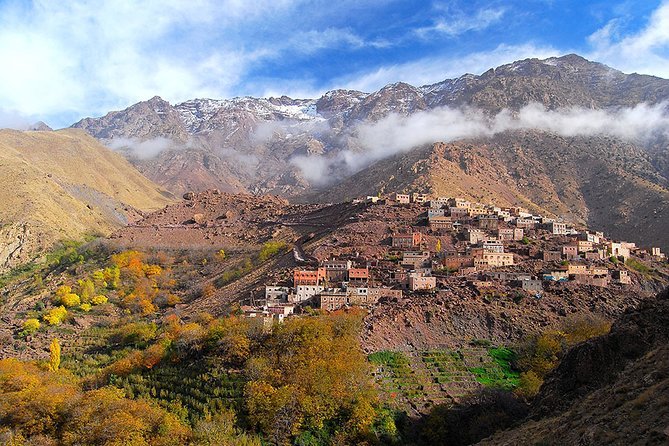
The 3-day Toubkal trek via Imlil gives a gentler pace for the same summit. The extra night is used either before the summit, to arrive at the refuge less tired, or after it, so the descent is split. Either way, you have more time to enjoy the Berber villages, eat properly and sleep, which noticeably raises the chance of reaching the top for first-time trekkers.
Three days also gives a weather buffer: if wind or snow makes the summit unsafe on one morning, your guide may be able to try again the next day.
How to decide in 4 steps
- Be honest about fitness. Can you walk 8–10 hours with 1,000 m+ of descent? If not, choose 3 days.
- Check your altitude history. If you have never slept above 2,500 m, the extra night is worth it. See our guide to altitude sickness on Toubkal.
- Look at the season. From November to April, choose 3 days. Read the best time to climb Toubkal.
- Think about the rest of your trip. If you continue to the Sahara the day after, a 3-day trek leaves you less exhausted for the long drive.
What about 4 days or more?
If you have the time, longer treks combine the summit with the quieter side of the massif. The 4-day Toubkal and Berber villages trek crosses the Tizi n'Mzik pass and the Azzaden valley, while the 6-day Toubkal circuit loops around the massif via Lake Ifni. These are ideal for walkers who want real mountain days rather than a quick climb. All options are listed on our Toubkal treks page.
Who should not do the 2-day trek?
- Anyone with no hiking experience on steep, rocky ground.
- Travellers flying in the night before with little sleep.
- Children and younger teenagers (a 3-day trek or a day hike in the Imlil valley is more suitable).
- Winter climbers without previous crampon experience.
For general information about the mountain and Toubkal National Park, the Toubkal National Park article is a useful starting point.
What a 2-day summit day really feels like
It helps to picture the second day of the fast itinerary before you book it. You wake up around 4 am at the refuge, often after a short and restless night. The climb to the summit takes most groups between 3.5 and 5 hours, depending on fitness and conditions. After photos at the top, you return to the refuge for a quick meal and to collect your belongings, then continue all the way down the Mizane valley to Imlil, passing Sidi Chamharouch and Aroumd. The descent to Imlil alone is long and steep, and it comes after the hardest climb of the trip. Many people arrive in Imlil in the late afternoon with very tired legs, then face the drive back to Marrakech.
For strong hikers, this is a satisfying challenge. For others, it can turn the summit into a test of endurance rather than a pleasure, which is why we always ask about recent hiking experience before recommending the 2-day option.
Training tips for both itineraries
- Walk regularly in the month before the trek, ideally on hills or with stairs, carrying a small daypack.
- Include at least one long day of 5–6 hours of walking to test your boots and your stamina.
- Strengthen your legs for the descent: lunges, squats and downhill walking help protect your knees.
- Practise using trekking poles; they reduce strain on the long way down.
- Sleep well in the days before the trek and avoid arriving in Marrakech the night before departure if you can.
Whichever itinerary you choose, the best preparation is honest communication with your guide about your fitness, your health and how you feel on the trail.
Key takeaways
- Both itineraries reach the 4,167 m summit; the difference is pace and acclimatisation.
- 2 days: fit, experienced hikers in summer with limited time.
- 3 days: first-timers, cooler seasons and anyone who wants to enjoy the trek.
- 4–6 days: for walkers who want the quiet valleys and passes of the massif.