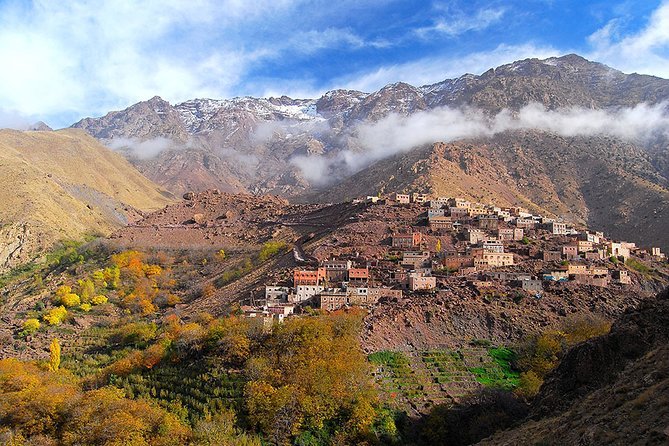
Every Toubkal ascent from Imlil has the same turning point: the night at the refuge. Tucked into the head of the Mizane valley at around 3,200 m, the Toubkal refuges are where you eat, rest and set your alarm for the summit. Knowing what the Toubkal refuge is really like (beds, food, toilets, cold, noise) makes the whole trek more comfortable.
Here is a practical, no-nonsense guide from our team, who spend a large part of the year there with trekkers.
Where is the Toubkal refuge?
The refuges sit at roughly 3,207 m on the main route from Imlil (about 1,740 m) to the summit of Jebel Toubkal (4,167 m). From Imlil, the walk takes about 4.5 to 6 hours via the village of Aroumd and the shrine of Sidi Chamharouch. From the refuge, the summit is about 3.5 to 5 hours away, which is why almost every ascent includes a night here.
There are two buildings side by side:
- Refuge du Toubkal, historically associated with the Club Alpin Français (CAF), the older stone refuge.
- Refuge Les Mouflons, a larger, privately run refuge just next to it.
Both offer dormitories, dining rooms and basic facilities. On a guided trek, your guide chooses and books the refuge.

Toubkal refuge comparison
| Refuge du Toubkal (CAF) | Refuge Les Mouflons | |
|---|---|---|
| Altitude (approx.) | 3,207 m | 3,207 m |
| Style | Older stone mountain hut | Larger, more modern building |
| Sleeping | Dormitories with mattresses and blankets | Dormitories; some smaller rooms may be available |
| Meals | Served in a shared dining room | Served in a shared dining room |
| Heating | Limited; dining room is the warmest place | Limited; dining room is the warmest place |
| Atmosphere | Traditional, often quieter | Busier, more international |
Facilities and services change over time; your guide will confirm what is available for your dates.
What is it like to sleep at the refuge?
Expect a mountain hut, not a hotel. Sleeping is in shared dormitories with mattresses side by side and blankets provided. Many trekkers sleep lightly the night before the summit because of altitude, excitement and the early start, so treat it as rest rather than a full night.
- Bring a sleeping bag or a liner for warmth and hygiene.
- Earplugs and an eye mask help a lot in shared dorms.
- Keep a headlamp, water and your layers next to your bed for the pre-dawn start.
- Toilets and washing facilities are basic; showers, when available, may not be hot.
Food and water at the refuge
On our treks, dinner and breakfast are prepared and served at the refuge: typically soup, tagine or pasta, bread and mint tea in the evening, and bread, jam, eggs or porridge and coffee or tea in the morning. Snacks, soft drinks and bottled water are sold, at mountain prices. You can refill bottles, but we recommend treating water with tablets or a filter.
How to prepare for your refuge night in 5 steps
- Arrive early to rest, rehydrate and acclimatise; a short walk above the refuge can help.
- Change into dry clothes as soon as you arrive so you do not get cold.
- Eat well at dinner even if your appetite is low; you need energy for summit day.
- Prepare your daypack the night before: water, snacks, warm layers, headlamp, crampons in winter.
- Sleep with your layers ready; the summit start is often around 4–5 am.

Is the Toubkal refuge cold?
Yes, especially outside summer. At around 3,200 m, nights are cool in July and August and properly cold in spring, autumn and winter. The dining room, with many people and a stove, is usually the warmest place. In winter, a sleeping bag rated well below zero is strongly recommended. Read our Toubkal winter guide if you travel between December and March, and our Toubkal packing list for the full kit.
Do I need to book the refuge?
Booking ahead is strongly advised, particularly in spring, summer and holiday periods. On a guided trek, refuge booking is part of the service. Our 2-day Toubkal summit trek and 3-day Toubkal trek via Imlil both include the refuge night. Longer routes such as the 4-day Toubkal and villages trek combine village gîtes with a night at the refuge.
For background on the mountain and the park, see Toubkal on Wikipedia.
The walk from Imlil to the refuge
Most of the refuge experience starts with the approach. From Imlil, the path crosses the Aroumd plain, a wide stony riverbed below the village, then climbs steadily up the Mizane valley. After about two to three hours, you reach Sidi Chamharouch, a small pilgrimage site around a white-painted rock, with stalls selling drinks and snacks. Non-Muslims do not enter the shrine itself, but you can rest on the terraces nearby.
Above Sidi Chamharouch, the valley becomes more mineral and the path zigzags up long slopes. The refuges only appear near the end, which can make the last hour feel long. Mules usually arrive before or around the same time as walkers, so your main bag should be waiting for you. In winter, snow can stop the mules lower down, and the last section may require crampons.
Refuge etiquette
- Take off your boots at the entrance and use the slippers or sandals provided, or bring your own.
- Keep the dormitory quiet in the evening: many people go to bed early before the summit.
- Pack your daypack the evening before so you do not rustle bags at 4 am.
- Take your rubbish back down; waste is difficult to manage at this altitude.
- Be patient at mealtimes and at the toilets, which can be busy in peak season.
What to do in the afternoon
If you arrive early, a short, slow walk above the refuge helps acclimatisation, following the old mountaineering principle of "climb high, sleep low". Otherwise, rest, drink tea, eat a snack and enjoy the view down the valley. Your guide will usually brief the group at dinner about the timing and plan for the summit morning, so it is a good moment to ask questions.
Key takeaways
- The Toubkal refuges are at about 3,207 m, 4.5–6 hours above Imlil.
- Two refuges: the older Refuge du Toubkal (CAF) and the larger Refuge Les Mouflons.
- Expect dormitories, simple meals, basic toilets and cold nights.
- Bring a sleeping bag, earplugs and a headlamp; guided treks include booking.